Perched precariously on the edge of the pot, Pan was in his element. Paws pumping, dirt flying, tail waving wildly, he quickly and professionally excavated the area, messily transferring potting soil from inside the heavy clay pot to a wide swath immediately surrounding it.

Pan and Trout dug under our shed to access a nest of baby rabbits. Dogs often dig for a purpose.
“What do you think you’re doing?!” I exclaimed as I turned around, dumbstruck at the amount of chaos a determined terrier cross could cause in only moments when my back was turned. In answer, Pan snorted up at me happily, eyes dancing in delight, before returning to his energetic digging. Gathering my wits, I asked him to “leave it,” which he did with a grin and a play-bow before zooming off in ecstatic circles around the yard. What a delightful time he was having!
Less delightful for me, of course. Only minutes before, I had carefully planted some [dog-safe] bulbs in that very same pot, placing them the proper distance apart before covering them with the correct depth of soil. I looked at them lying on our cement patio. I looked at my dog, bounding around in pure joy. It was time to do some training.
Digging is a common behavior for all dogs, and especially for certain breeds such as terriers and dogs with more primitive roots. There are many reasons why your dog might dig, and one of the first things that you need to do is figure out what’s motivating your pup to let their paws fly.
Most commonly, dogs dig for fun. It just plain feels good! There’s something especially satisfying about the feel of loose dirt or sand between their paws.
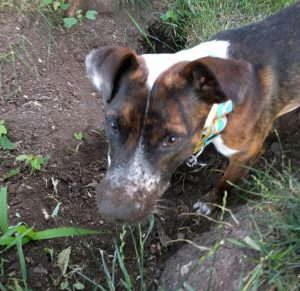
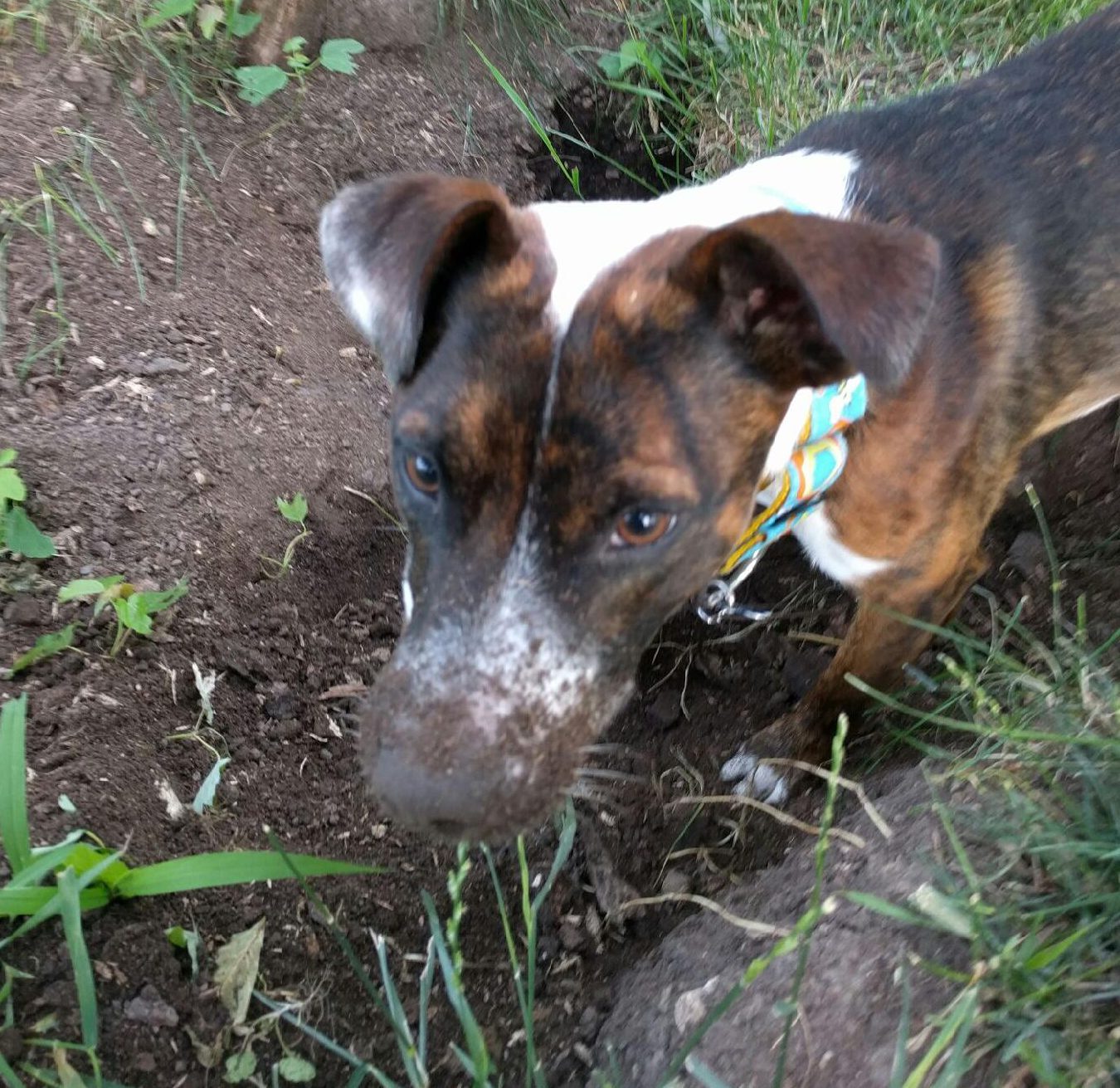
Pan just cached a special chewy in this hole. Photo by Matt Helgemoe.
However, dogs will also dig for more practical reasons. Many dogs will dig holes to cache special treasures such as treats or toys, covering their prize carefully after depositing it in the hole by scooping dirt or sand back over it with their nose. You may also see this behavior indoors, when your dog pushes blankets over his food bowl or perhaps even makes the motions of scooping with his nose in the air above a special prize. Dogs also dig due to social facilitation. This is why your dog might start digging next to you in the garden every spring – your digging prompts his interest, and he joins in on the activity. Dogs will dig with one another, too. Some dogs will dig burrows, especially if they are hot. Digging into the cool earth provides them with a more comfortable place to rest away the heat of the day. Some pregnant dogs are determined to dig a “den.” Dogs will also dig to achieve a goal, such as escaping from under their fence to go on a grand adventure, or digging under your shed to get to that compelling nest of baby bunnies.
If your dog is digging for a specific reason, addressing that reason completely resolves the digging. For example, our older dog Trout dug out of our yard multiple times shortly after we moved. Every time we thought we had Trout-proofed the yard, she showed us a new weakness in our fortifications! Luckily, Trout is always supervised, so we were able to quickly retrieve her before she wandered onto the nearby busy road.
Trout’s digging issues were fairly easily resolved through management. We prevented her from digging by burying cement blocks in all of her favorite digging locations. We also used ex-pens to shore up any weak areas where she could squeeze under the fence until we were able to build a better barrier to keep her in the yard. We didn’t just take away her digging options, though. Digging out of the yard told us that Trout was bored, and the world outside her backyard looked much more green than the ground she’d already explored inside her highly-reinforced “AlcaTroutz.” So, we needed to make things more interesting.
Increasing the excitement of the backyard wasn’t difficult, but it did require some minor maintenance. Sprinkling interesting scents in random areas of the yard kept things interesting for Trout. A small handful of used hamster bedding, a few feathers from a friend’s chicken, or the dust from the bottom of a bag of beef liver dog treats were all big hits. Trout also thought that the trail of juice dribbled from a can of tuna was fascinating, and she loved it when we threw a small handful of treats out in the grass for her to find. Of equal enrichment value was our brush pile. After we removed two arborvitae from alongside our house, the brush became a frequent playground for her. She climbed, burrowed, and sniffed amongst the branches for hours. We made sure to position this brush pile well away from the fence so as not to provide a convenient staircase into the world outside her yard, and Trout soon stopped attempting to dig out at all as her backyard became the paradise that she’d always assumed the rest of the neighborhood to be.
Providing enrichment such as novel scents, sights, sounds, obstacles, and toys in the yard is one great way to reduce your dog’s digging, especially if he or she is digging out of boredom. However, I recommend against doing away with digging altogether for the vast majority of dogs. Digging is great enrichment, a great stress-reliever, and wonderful exercise! Instead of forbidding your dog from digging, I recommend that you instead channel his or her digging skills into appropriate outlets.
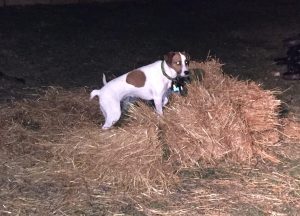
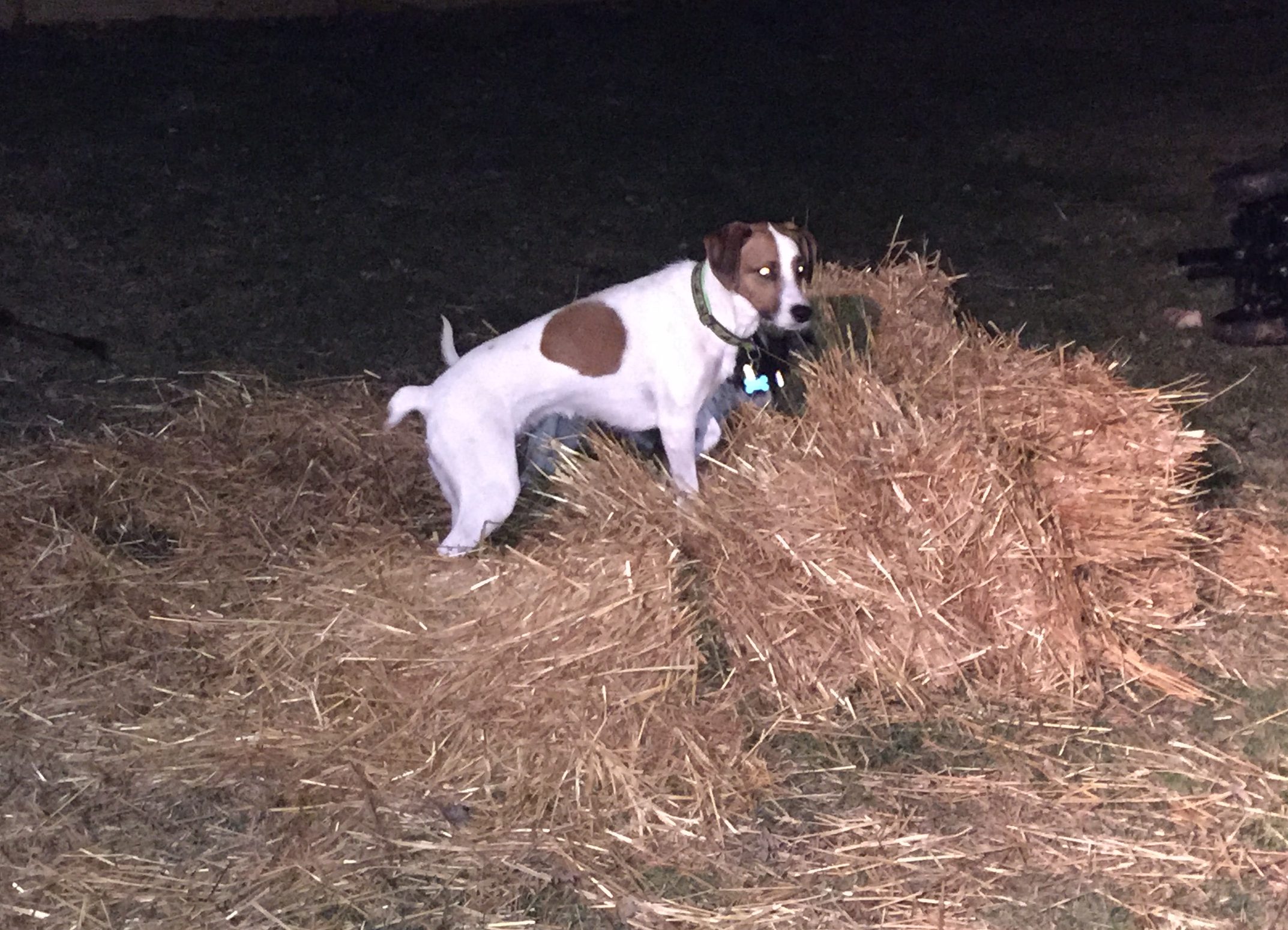
Trout and Pan dig apart their straw bale.
How you do this depends on your available space and how much your dog likes to dig. Those with less space can use a single straw bale sprinkled liberally with treats to create a fabulous digging surface (let your dog tear the bale apart, don’t bother spreading it out yourself). A wide, shallow rubbermaid tub can also be filled with shredded paper, strips of fleece, or even playground sand, and provided for your dog once a week (or more) in an easily-cleaned room of your home (bonus: it’s quite satisfying to vacuum up all of the spilled sand afterwards). Or, you can go to the gold standard in doggy delight: create your very own digging pit.
A digging pit is a clearly defined area where you not only allow, but encourage your dog to dig. You can mark this out with wooden planks, cement blocks, flags, or other landscaping materials. I decided to go with a large box made of treated cedar planks, which was situated on a gravel bed in my backyard. In my last several homes, our digging pits have been made up of a children’s plastic sandbox (with a lid to keep out brave but suicidal neighborhood cats, whom my terriers may not have greeted kindly on their turf), a bed of straw under a deck, and a sand/clay area where nothing but a couple of determined hostas grew, which I marked out with fist-sized rocks in a large square. Look at your available space, and determine what you can provide.
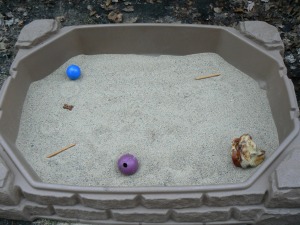
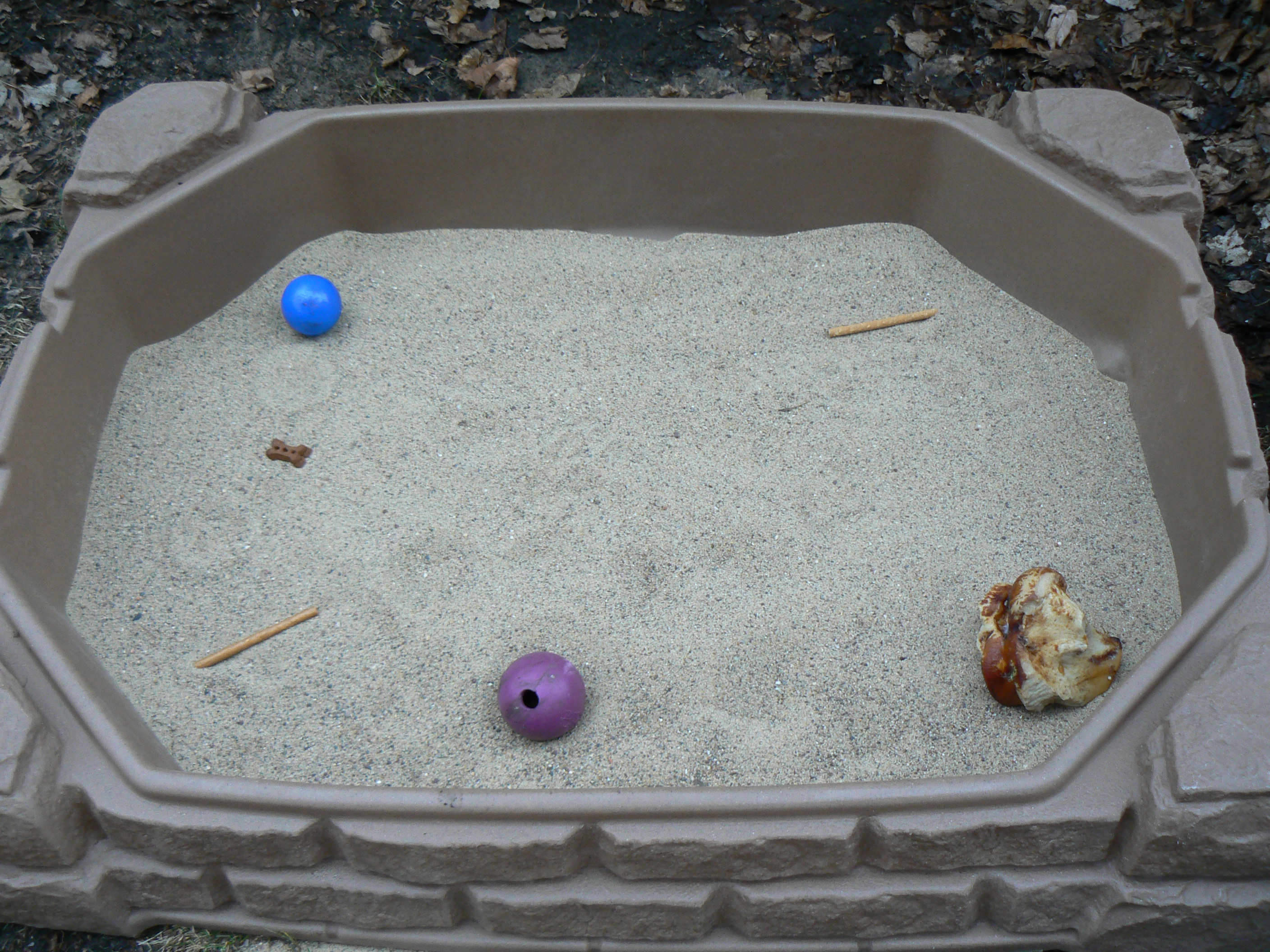
Add interesting items, like toys or treats, to your dog’s digging area to keep them coming back.
Now comes the fun part! Most dogs are delighted to discover that there’s an area where they can get their legal digs out. Make the area extra enticing by burying prizes for your dog to find. Hard biscuits, dental chews, bones, toys, and bully sticks are all good candidates. Start by making it really easy for your dog to “win” in their digging pit lottery by sprinkling some small treats on top of the dirt or sand in that area. As your dog starts to show some interest in the magic treat spot, let him or her watch you as you theatrically bury a larger biscuit under a very shallow layer of substrate. Then, encourage your dog to get it. Help him dig, if he seems hesitant! Remember, social facilitation is huge for dogs, so when he sees you digging and hears you encouraging him to join in, he’s much more likely to get into the game. Really make a big deal over him when he digs up the treat, regardless of whether he used his nose or paws to extract it.
As your dog gets better at the digging game, you can make the challenges you provide for him harder. Bury prizes more deeply, or do so when he’s not looking so that he has to use his nose to find them. Planting “surprises” in the box once or twice a week will keep him heading back to the same spot over and over to see what fun he can [quite literally] dig up each day. It’s okay – even good! – if your dog doesn’t find anything most of the time when he digs. As long as he keeps getting rewarded for digging in your designated area on occasion, he’s going to keep playing the digging lottery in that special spot that sometimes pays off.
Providing your dog with a designated digging pit isn’t enough to stop him from digging in other areas, however. As Pan proved with his potted planter excavation, dogs need some additional training to learn where they are and are not allowed to do their yardwork.
This is easily accomplished with supervision, redirection, and most of all, consistency. After his joyful hole creation, I watched Pan carefully. Anytime he started to dig in off-limits areas of our yard, I interrupted him with a cheerful “leave it!” or “oops!” and an invitation to run to the sandbox. Anytime he went to the sandbox on his own, I praised him profusely. Sometimes, I ran over and planted a prize for him to dig up. Sometimes, I ran over and dug with him, using my hands or a small trowel to dig alongside him (a reward even better than food for Pan, who relished the chance to do something fun together). Sometimes, I’ll be honest… I lay in my hammock and simply praised from afar, too comfortable to get up. Hey, dog training doesn’t always have to be a lot of hard work!
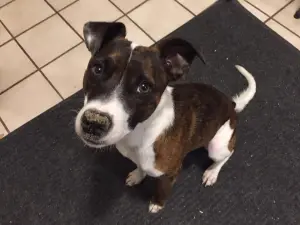
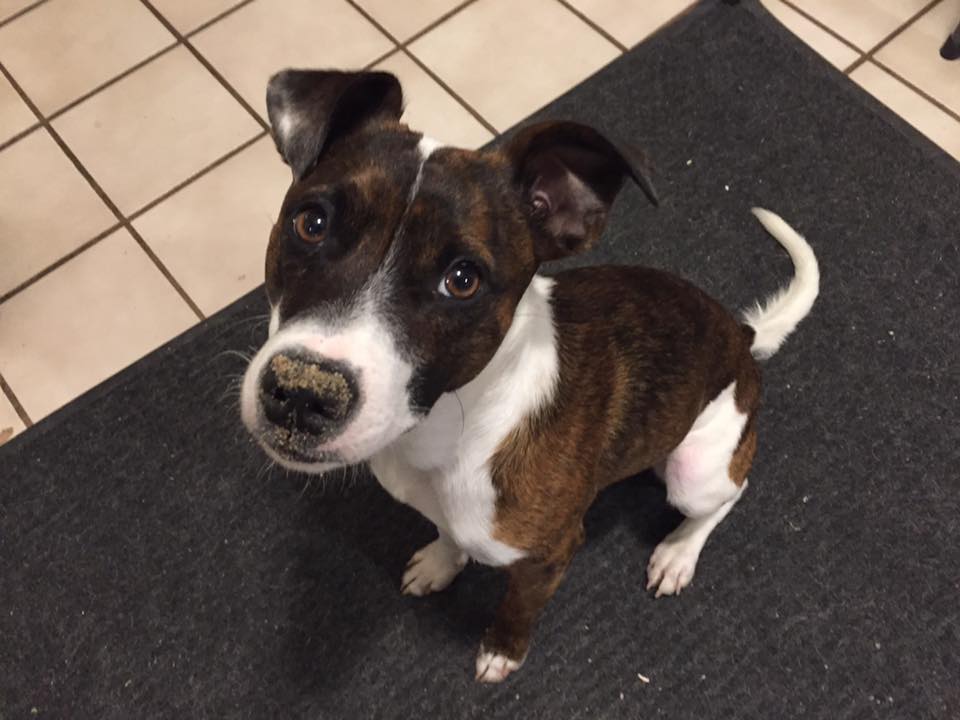
Pan’s nose is still sandy from caching his deer antler.
Our first “aha!” moment actually happened late at night. I was finishing up some bookkeeping indoors when Pan asked to go outside. He’d been given a new deer antler chewy earlier that day, and when I opened the back door he ran to retrieve this prize from where he’d buried it under his dog bed in his crate. I waited patiently while he found a spot to pee in the yard, antler in mouth. He then ran over to his sandbox, where he spent almost fifteen minutes under the light of the moon carefully excavating a hole, depositing his treasure, and covering it with layers and layers of sand. He came back in with his head covered in sand, a big smile on his face. Mission accomplished! He could sleep easily, prize cached in a safe location. The next morning, my husband reported that Pan dug his antler up first thing before once again conscientiously caching it under the sand.
Over the course of a month, Pan’s digging attempts in other areas of the yard became both less common and less intense. However, his digging in the sandbox continued on, strong as the day we’d built it. He cached treasures, dug up treasures, and oftentimes dug just for the delight of the sand beneath his speedy paws. I replanted the flower bulbs, which grew quickly in spite of their early and abrupt departure from their home. Pan left my pots of plants alone. He left the soft earth where a tree stump had been removed alone. He joined Trout in digging under our shed to devour a nest of bunnies, and we added gravel, landscape boulders, and an ex-pen around the back of the shed to keep our suicidal long-eared guests safe. He gave up on the shed and went back to his sandbox. I stopped having to issue “leave it” reminders.
Too often in our dogs’ lives, we forget to let them be dogs. We forget that they’re intelligent, autonomous beings with their own likes and dislikes.
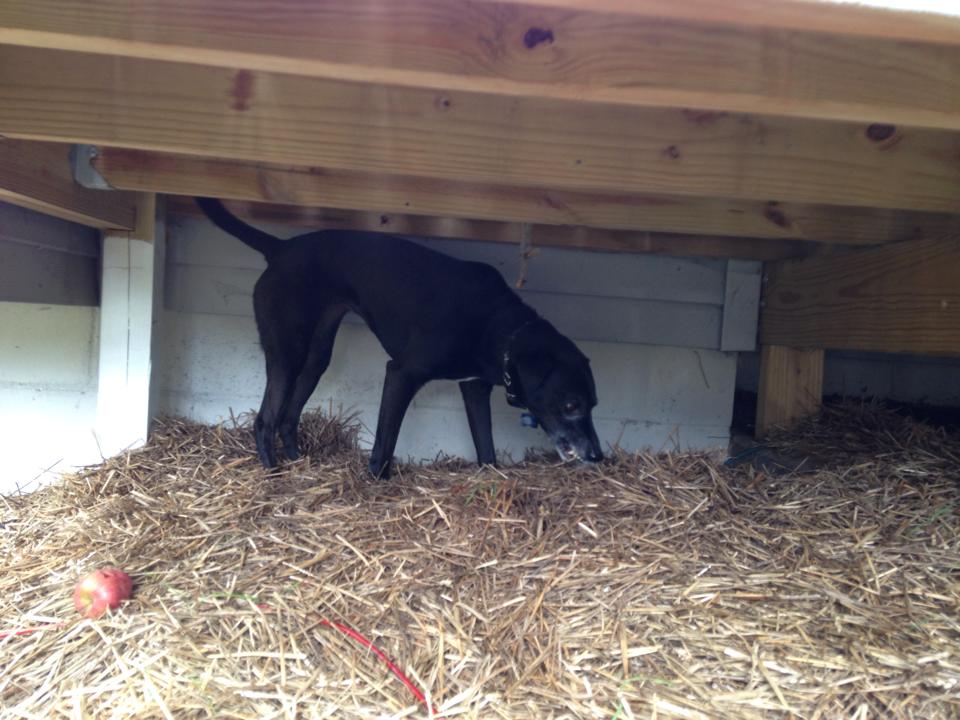
Layla chomps on a crab apple that she’d cached in her straw digging area.
Activities like barking, chewing, chasing, and digging aren’t intrinsically bad. The problem comes not from the activities themselves, but from when and where your dog engages in them. Rather than punishing normal and natural canine behavior out of your best friend, consider instead whether you can direct it into a more appropriate channel. Consider how very good that activity feels to your dog. Consider how that activity benefits your dog: in the feeling of fulfillment from carrying out a centuries-old instinct, in the discharge of pent-up energy or anxiety, or perhaps in the cascade of dopamine that enjoyable activities releases. Why take that away from your best friend?
What opportunities do you provide for your dog to dig? Please share your stories in the comments section below!





 Paws Abilities